 Mehmut Naser
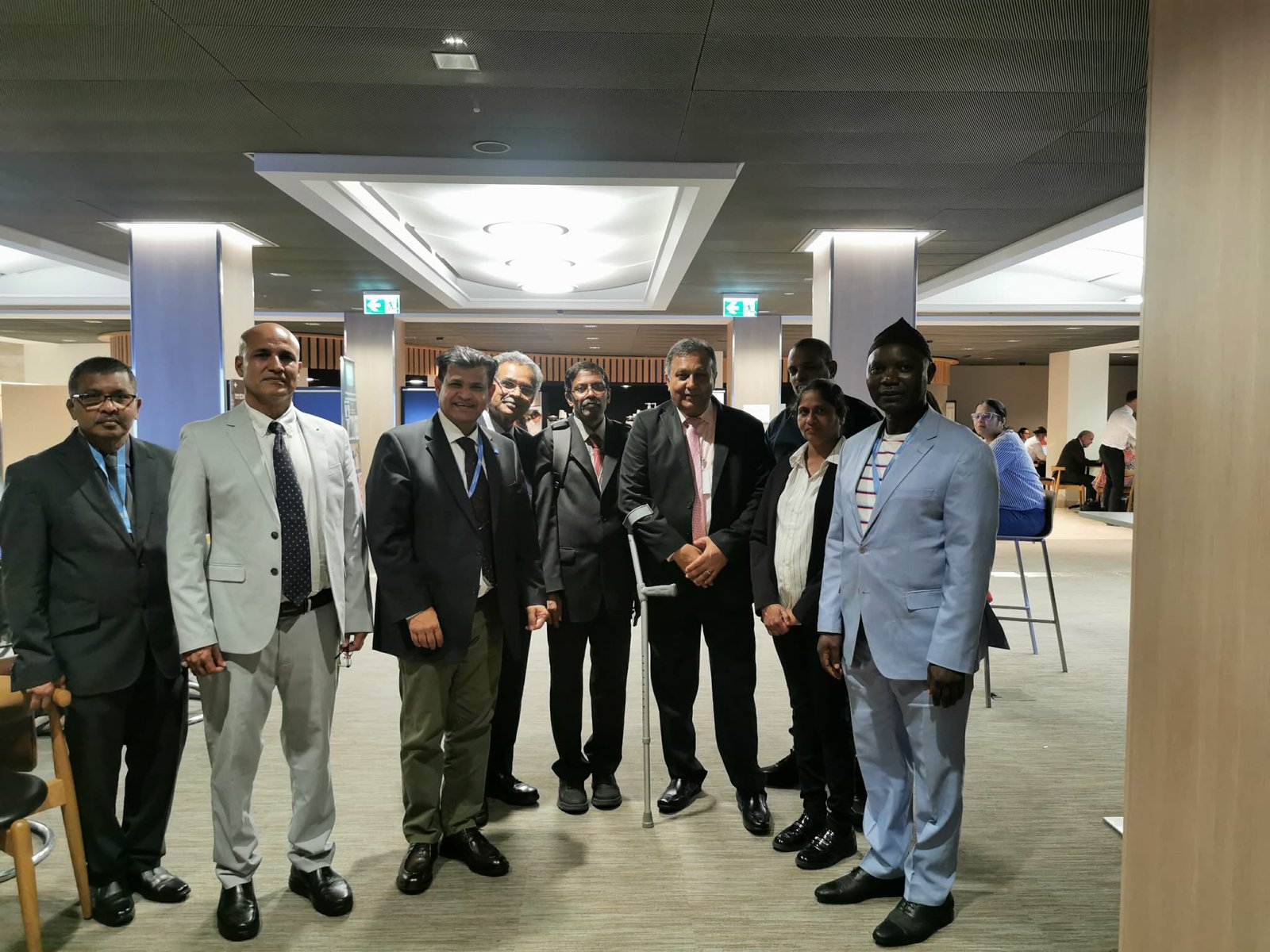
Delivered during the Interactive Dialogue with the UN Working Group on Enforced or Involuntary Disappearances — Agenda Item 3
Date: 15 September 2026 | Venue: United Nations, Geneva | Document type: Joint Press statement
We, the undersigned representatives of the Baloch, Pashtun and Tamil peoples, address this statement to the United Nations Human Rights Council, its treaty bodies and Special Procedures mandate holders, and in particular to the Working Group on Enforced or Involuntary Disappearances (WGEID). We speak on behalf of communities that have endured, and continue to endure, the crime of enforced disappearance at the hands of state forces. We seek urgent attention of this Council and call upon the United Nations body to take effective and timely steps to save the lives of the victims of enforced disappearances before it is too late.
Enforced disappearance is a continuing crime. Each day that a disappeared person’s fate and whereabouts remain unknown is a fresh violation — of the victim, and of the family left in perpetual anguish. For the Baloch, Pashtun and Tamil peoples, this crime is not an isolated aberration but a systematic and institutionalised practice, sustained by entrenched impunity. We bring before this Council three distinct contexts bound by a common thread: the failure of states to account for the disappeared, and the failure of the international community to act decisively while the numbers multiply year after year.
The Scale of the Crisis at a Glance
| COIED CASES REGISTERED (PAKISTAN, SINCE 2011) 10,6361,650 still under investigation as of Sept 2025 | PASHTUN PERSONS STILL MISSING4,319of 4,637 documented cases |
| BALOCHISTAN DISAPPEARANCES DOCUMENTED (2025) 1,395 70.2% remain disappeared, The Baloch claims Tens of Thousands subjected to Enforced Disappearances. |
The Pashtoon People: A Trauma-Induced Silence
“The issue of enforced disappearances has traumatised the Pashtun society. People have been disappeared by force, and if anyone raises the issue, he or she herself becomes a victim of enforced disappearance. This has created a climate of fear that silences the very voices that seek justice.”
— Mr. Fazal Ur Rehman Afridi, Representative of the Pashtun People
The Pashtoon people of Khyber Pakhtunkhwa and the former tribal belt have borne the brunt of enforced disappearances in Pakistan. The Commission of Inquiry on Enforced Disappearances (COIED) has recorded over 10,000 cases since 2011, of which 3,485 were from Khyber Pakhtunkhwa alone — more than any other region [1]. Independent documentation by the Pashtun National Jirga indicates that over 4,000 Pashtuns remain missing, many believed to have been abducted, tortured and killed in extrajudicial executions [2]. A detailed missing-persons registry lists 4,319 individuals still missing out of 4,637 documented cases, with the overwhelming concentration — 4,165 cases — in Khyber Pakhtunkhwa [3].
The repression extends beyond the disappeared to those who dare to speak. Activists associated with the Pashtun Tahafuz Movement (PTM) and human rights defenders have themselves been targeted for abduction, including the disappearance of youth after a “peace jirga” — a betrayal of the very forums meant to resolve grievances [4]. In April–May 2025, the WGEID took the unusual step of issuing a general allegation to Pakistan at its 136th session, underscoring rising concerns about impunity [1].
The Baloch People: A Crisis That Has Multiplied Many-Fold
“The Working Group shall make a follow-up visit to Pakistan. After 2012, the Group has not done a follow-up visit, and the number of victims has multiplied many-fold. There is a high need to do a follow-up visit to know the exact situation on the ground.”
— Mr. Munir Mengal, Representative of the Baloch People
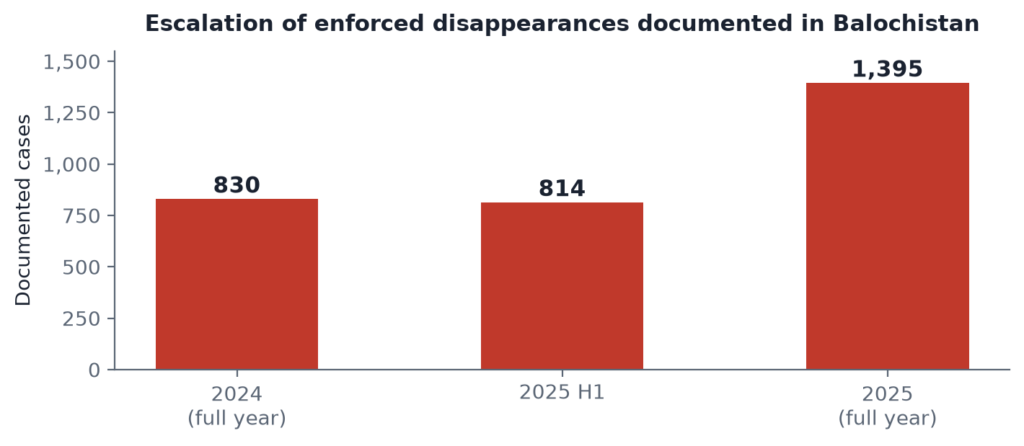
The Baloch people have faced enforced disappearance as a weapon of repression for over two decades. Human rights organisations estimate that approximately 15,000 people have been forcibly disappeared in Balochistan since 2003 [5]. The scale has escalated sharply: in the first six months of 2025 alone, the Human Rights Council of Balochistan documented 814 cases of enforced disappearance — nearly equalling the 830 cases recorded throughout all of 2024. Of those, 555 remained missing, 211 were released, and 46 were killed [6]. For the full year 2025, independent human rights monitoring organisations documented 1,395 cases, with 70.2% of victims still disappeared, alongside 194 extrajudicial killings [7]. Students accounted for 57% of identified victims, and the number of women and school-aged children subjected to disappearance continued to rise. This figure reflects the full-year 2025 documentation by independent human rights monitoring organisations in Balochistan.
The official COIED figures — 2,752 cases from Balochistan since 2011 [8] — are widely regarded by families and organisations such as the Voice of Baloch Missing Persons as gross under-reporting, with other estimates reaching 15,000 cases [8]. Where as the Baloch organizations and civil society representatives claims Tens of thousands of People subjected to enforced disappearances in Balochistan.
The WGEID conducted its only country visit to Pakistan from 10 to 20 September 2012, visiting Islamabad, Lahore, Karachi, Quetta and Peshawar [9]. Its 2013 report expressed concern at the continuing practice and made a series of recommendations [10]. A 2016 follow-up assessment by the Working Group regretted that most recommendations had not been implemented and noted that the Government had failed to communicate a single case in which perpetrators were held accountable [11]. Despite this, no follow-up country visit has been undertaken in the fourteen years since — while the number of victims has multiplied many-fold.
The Tamil People: The Urgent Need for an International Accountability Process
“There is an urgent need of a UN-led or international Criminal Justice Mechanism to investigate War crimes, Crimes against Humanity and Genocide and disappearances. Domestic mechanisms have failed the victims. Only an independent international process can deliver the truth and justice that the Tamil people have waited decades for.”
— Mr. V. Ravi Kumar, British Tamils Forum (BTF)
Tamil victims, families of the disappeared, survivors, and communities in Sri Lanka’s North and East continue to await truth, justice, reparations and guarantees of non-recurrence.
Seventeen years after the armed conflict, more than 18,000 Tamil families remain without answers about the fate and whereabouts of their loved ones while facing years of surveillance, intimidation and harassment for seeking answers.
The UN Committee on Enforced Disappearances has expressed serious concern regarding the 16,966 cases received by the Office of Missing Persons.
Patterns of unlawful killings, enforced disappearances, torture, sexual violence and other grave violations documented by OSLAP should be recognised as potentially constituting serious international crimes, including war crimes, crimes against humanity, and genocide against the Tamil people.
Mass graves, including Chemmani, demand credible, independent international forensic investigations and DNA testing with international expertise.
“How can there be transitional justice when Tamil victims are denied truth and justice, while grave violations continue to be denied?
Under Human Rights Council resolutions 46/1 and 51/1, the OHCHR established the Sri Lanka accountability project (OSLap) to collect, preserve and analyse evidence of violations and to develop strategies for future accountability processes [16]. The Tamil people urge this Council to build on that foundation by establishing a fully-fledged UN-led international criminal justice mechanism with the authority to investigate Genocide, war crimes, crimes against humanity and enforced disappearances, and to hold perpetrators to account.
Comparative Overview of the Three Contexts
| Community | State context | Key documented figure | Primary state response |
| Pashtun | Pakistan (Khyber Pakhtunkhwa) | 4,319 still missing | Criminalisation of protest; general allegation by WGEID (2025) |
| Baloch | Pakistan (Balochistan) | 1,395 cases in 2025; ~7,000 since 2003 | No WGEID follow-up visit since 2012 |
| Tamil | Sri Lanka | ICRC reported that it was trying to trace 15,780 people in Sri Lanka as of 31 December 2011. | Failed domestic commissions; no prosecutions |
Recommendations and Calls to Action
We respectfully but urgently call upon the Human Rights Council, the treaty bodies and the Special Procedures, and in particular the Working Group on Enforced or Involuntary Disappearances, to take the following effective and timely steps:
1. Undertake a follow-up country visit to Pakistan without further delay. Fourteen years have passed since the 2012 mission, during which the number of victims has multiplied many-fold. The Working Group must return to Balochistan and Khyber Pakhtunkhwa to assess the exact situation on the ground and to verify the implementation — or non-implementation — of its 2012 recommendations.
2. Establish a UN-led or international accountability process for Sri Lanka. Domestic mechanisms have demonstrably failed. The Council must move from evidence-preservation to an international criminal justice mechanism with the mandate and authority to investigate genocide, war crimes, crimes against humanity and enforced disappearances, and to pursue criminal accountability.
3. Take effective and timely steps to save the lives of disappeared persons. Enforced disappearance is a continuing crime that places victims at ongoing risk of torture and death. Urgent intervention and interim measures are required to locate victims and prevent further harm while cases are pending.
4. End reprisals against those who speak out. The pattern by which human rights defenders and family members are themselves disappeared for raising the issue must be recognised, condemned and specifically monitored, with protection extended to victims’ families and advocates.
5. Urge Pakistan to ratify to fully implement the International Convention for the Protection of All Persons from Enforced Disappearance (ICCPED). Criminalise enforced disappearance as a distinct autonomous offence in domestic law, in line with the Convention and with the recommendations already accepted by Pakistan during its Universal Periodic Review.
6. Address the structural impunity that enables these crimes — including the lack of independent oversight and accountability of security and intelligence agencies, and the failure to prosecute a single perpetrator across all three contexts.
The Baloch, Pashtoon and Tamil peoples do not ask for exceptional treatment. We ask for the universal protection that international human rights law guarantees to every person. We ask that the mechanisms of this Council function not as repositories of documentation, but as instruments of action. Every day of delay is measured in lives — lives of the disappeared, and lives of the families who wait, and who are dying, for the truth.
Sources and Underlying Data
[1] Pashtun Rights Advocates Rally in Geneva, PJ Media (Sept 2025); Amnesty International / COIED tallies.
[2] Pashtun National Jirga condemns enforced disappearances, The Tribune (Sept 2025).
[3] Pashtun Missing Persons report — Press Club of Switzerland (2025).
[4] Betrayal at the Peace Jirga: Enforced Disappearances of Pashtun Youth, Raise The Voices (2026).
[5] Unseen Shadows: The Crisis of Enforced Disappearances in Balochistan (2026).
[6] HRCB Bi-Annual Report 2025 — Balochistan enforced disappearances.
[7] Annual Report 2025: Escalating Enforced Disappearances in Balochistan.
[8] Balochistan’s enforced disappearances, South Asia Monitor (2024); COIED 2024 report.
[9] WGEID concluding statement, mission to Pakistan (Sept 2012).
[10] WGEID mission report on Pakistan (A/HRC/22/45/Add.2, 2013).
[11] ICJ — Justice for “disappearances” (WGEID follow-up, 2016).
[12] OHCHR — Sri Lanka: Accountability needed for enforced disappearances (May 2024).
[13] WGEID report on Sri Lanka — over 12,000 cases transmitted.
[14] OHCHR — Accountability for Enforced Disappearances in Sri Lanka (report, 2024).
[15] Faith in Sri Lanka’s Government Risks Extending Impunity, Just Security (Nov 2025).
[16] Update on the OHCHR Sri Lanka accountability project (April 2025).
This statement is issued in the name of the representatives of the Baloch, Pashtoon and British Tamils Forum (BTF) for circulation during the 63rd Session of the UN Human Rights Council. Figures cited are drawn from the United Nations human rights system, international non-governmental organisations and documented community registers current as of 2025–2026.Joint Statement on Enforced and Involuntary Disappearances of the Baloch, Pashtoon and Tamil Peoples
Delivered during the Interactive Dialogue with the UN Working Group on Enforced or Involuntary Disappearances — Agenda Item 3

 Zeynep Aziz